Pinterest

Showing posts with label vegetables. Show all posts

Tuesday, February 11, 2014

How Gardening (Practically) Saved My Life...


Yes, I know the title sounds extreme and dramatic but let's face it; in the big picture of things it's true.  Before gardening, my dinner plate was a literal world of tan and brown with no intention for change.  I lived thinking that carbs were the new green and I embraced their ability to bring me comfort and joy.  Vegetables were the enemy and the further away I could be from them the better.  

Oh, I embraced the perennial favorite, corn-on-the-cob and well, that was it.  Really.  I know...so sad.  It's not that I didn't want to be healthy, but hey - I was young and my body could take it!  So, I fed it lots of comfort foods and when I ate a small amount of green beans or an occasional salad, I figured I was "doing my body good." 


It wasn't until I began to have digestive issues that I began to take my health more seriously.  I was convinced that I was dying and when the doctor told me that I just needed more fiber, I was insulted.  How dare he say that what I had could be fixed by me eating better!  So, I added more fiber to my diet...like the Metamucil kind until I learned how I could get all the fiber I need from vegetables and fruit - who knew?!

Enter gardening.  I always liked to grow things when I was a kid...but these were of the flower nature.  So I started to plant lots of flowers...I mean lots.  I put them all over our small little yard and I still have a lot.  Then I progressed to herbs...after all, they flowered too and I was fascinated by the fact that you could eat and drink them and they could help you too.  Then I thought, why not plant a few tomatoes and a pepper plant or two as well?  Once that happened, I decided to can what I grew and the garden jumped into life.
So, I want to share with you how gardening is a practical way to "save" your life and learn how to eat better. 

1. Gardening Connects You to Your Food.
       I know it may sound silly, but when you grow it, you feel connected to your food.  You know the work and the effort that went into tilling and raking the soil, planting the seeds, and pulling the weeds.  It's a lot of effort and it makes you appreciate what you've had just grown.  It's way different than buying produce at the store. You didn't nurture that vegetable and you don't know where it came from - in other words, you have no emotional connection to it.  As strange as it may sound, planting the vegetables made me want to eat them!

I remember always planting a small patch of baby carrots and pea pods for our then toddlers.  I would tell them where "their" garden was and they would wander in and snack on them at will.  I'll never forget the time when our younger son came into the house with a dirt ring around his mouth after pulling some carrots...I very quickly introduced him to the garden hose!  The point is, he felt connected to his food and still loves those vegetables to this day.


2. "If You Plant It, You Must Eat It."
       This is very similar to the first reason; feeling connected to your food except in this case, it's more about feeling "responsible" for eating what you grow.  Yep, it's true.  I thought, "Wow, I just planted 10 rows of green beans and I really should can them and then eat them."  I never liked green beans.  I mean, I hated green beans.  However, they are one of the easiest veggies for me to grow and I grew them like crazy.  I had mountains of beans.  I felt very successful as a gardener but in order for that success to make sense, I needed to actually consume what I grew.   And I did, but I admit, very slowly!  

I also began to realize that if I actually ate what I grew, I could save some $$.  The practical side of me responded to this very much and I began to experiment with the vegetables, trying to find ways to "hide" them in food so I would eat them.  It eventually worked and I actually like green beans now and have fun growing lots of different varieties. 


3. Gardening Introduces You to Unique and Different  Vegetables.
      Everything from tomatillos to Mizuna...gardening has expanded my mind and palate to new flavors and textures.  After a while, growing just tomatoes, peppers and green beans radically expanded to new frontiers of vegetables like the vertical growing green; Malabar Spinach (which grew over 15 feet tall) to unique varieties of edible flowers.  I was amazed at all of the vegetable catalogs and the wealth of vegetables which were available to grow.

I began to include new and different varieties of the basic vegetables as well as including new kinds I had never tried before.  I remember talking about eggplant with my 100% Italian brother-in-law.  I began growing them, initially to give them to him and not realizing how many fruits they put on.  I knew we needed to start eating them too and eat them we did...slowly at first and now I don't think they've missed a season in our garden since...and that's been well over 20 years!  We grow them now because we love them and miss having them on our plates.  I have grown many different varieties of them as well.

There are many other reasons why gardening has "saved" my life, like the fact that it's a super fulfilling and even relaxing hobby.  I get so energized and yet still peaceful at the same time whenever I'm around my plants.  

And my health?  No more digestive complaints and I've been able to maintain the same healthy weight for over 20 years.  I thank my veggies for lending a hand in all of this and look forward to gardening for many years to come.  Most active gardeners live a long and healthy life!

I hope you are inspired to grow your own vegetables if you aren't already and maybe share how they helped to save your life as well!

How has gardening impacted your life?


Linked to these amazing blog parties...Waste Not, Want Not Wednesdays
Frugal Days, Sustainable Ways

Thursday, October 3, 2013

Eating Well in the City: West Side Market


One thing is for sure; the city offers some amazing spaces, great architecture and interesting places.  We live only 40 miles away from Cleveland and manage to go downtown every once in a while.  When we do, discovering the food it has to offer has to be top on our list. 

The food doesn't have to just come from a restaurant either.  As a matter of fact, visiting its city market is one of my favorite places to go.  With roots going back to the 1840's - this market boasts of not only great food, but is full of history as well.  I end up feasting with my eyes as well as my appetite.

It is home to over a hundred vendors and believe me, they sell everything.  It's an eater's paradise.  The variety is endless and begs of repeat visits to at least get a glimpse of all that is for sell.

This leads me to my next thought...Eating well in the city is actually easier than I would have thought.  Sure, you have to walk past all the racks and displays of cookies, pastries, cakes, and candy (it's really ok to nibble along the way) to find some vendors that offer artisan breads, cheeses, and produce.   


A city market does so much for the local economy.  It provides small businesses great opportunities to thrive and grow.  It provides an outlet for small farmers and gardeners who need to sell produce.  It encourages artisanal foods and recaptures old world methods of growing, baking, cooking and eating. 


 It also is a vast artistic display that encourages creativity not only in food but in the way we think about food.  There's no way I'm thinking about french fries and pizza here...too many other great foods to discover and explore.


It really is a center and a gathering place for young and old alike to celebrate ethnic heritages, great food and learn new traditions.

With this constant traffic flow of produce and food from the burbs and countryside, it ensures the quality of food for many urban dwellers.  I am almost thinking that it's a bit easier for them to eat well at least when it comes to having more healthful choices.  
 

I know we ate really well that day and came home with some prizes too.  With new vendors selling Black Tuscan Kale and other organic produce, I felt as if I was walking through a garden. Looks like city pavement owners have their own bit of livin' in the green as well.
 

What's your favorite town or city market space?  Blessings!


For more info on the West Side Market, click here.

Linked to these amazing blog parties... Frugal Days, Sustainable Ways ,
Homestead Barn Hop
Waste Not, Want Not Wednesdays 

Tuesday, July 2, 2013

The Importance of Pollinators in Your Garden


 There's nothing like seeing lots of beautiful flowers and an overflowing garden of produce.  But what's the secret behind this fruitfulness?  That would be where pollinators come in.  Most flowering plants depend on bees, butterflies, animals (hummingbirds and bats) and even flies and wasps for pollination.  

What is pollination?  It's basically the act of moving pollen from the male stamen to the female stigma and fertilizing the plant which then causes it to set seed.  Insects and animals help to do this in your garden.  Pollinators are called "Keystone Species" because they are species on which other species depend.  In other words...if you want zucchini and tomatoes, you want pollinators.

Calendula flowers in the Garden

We need pollinators and they need our help.  "Pollinators are vital to maintaining healthy ecosystems.  They are essential for plant reproduction and produce genetic diversity in the plants they pollinate.  The more diverse plants are the better they can adapt to the changes in the environment."1


An Uncommon Black Parsley Swallowtail Caterpillar.  Butterflies are pollinators too.

 How can we attract more pollinators to our gardens?  
This is a great question and fairly simple to do.  Many gardeners are doing it already without knowing it.  I know I began to learn about pollinators after watching them in action in different flower beds.

1. Plant a rich diversity of flowering plants in your flower beds and garden. 
 Seems like a simple plan but it does help to get some ideas by seeing which plants attract what insects in your garden.  I was able to observe this firsthand and found that mints are a huge pollinator attractor.  I mean huge.  It's worth planting some in a contained area just for this alone. Plant pollinating attracting plants in the garden around the vegetables too.  It will give the bees and other insects lots of pollen variety.

Also, by planting diverse plants and flowers, we are offering different sources of nectar (which of course attracts pollinators) and different bloom times which will provide food sources and pollen all season long.  Don't forget simple species such as marigolds and classic zinnias.  They are always drawing bees as well as butterflies to the garden.

This pollen-rich Sweet Alyssum attracts a pollinating fly.

2. Plant lots of native perennial and annual species. 
 Ever notice that some plants seem to have LOTS of activity around them?  These are the species you'll want to plant.  In the northeast United States, Echinacea, Bee Balm (Monarda), Gaillardia, Rudebeckias and daisies seem to be big attractors.  Don't forget herbs as well.  Lavender, thyme and mints are totally loved by bees and other insects alike.  I've even seen hummingbirds amongst my sage flowers drinking the nectar...who knew?

Pollinators include all kinds of bees and wasps.

 3. Don't use pesticides in your garden.  
This seems like the easiest step to help out the pollinators...no spraying.  I try to garden and plant vegetables and plants that are very insect resistant.  If it's very fussy...I won't grow it.  If I do ever spray, I use a plant-based biodegradable spray that will break down eventually.  Also spraying on a non-windy day helps.  I prefer to rarely use any kind of spray though and will hand pick offending insects whenever possible. 

Flowers that have an open petal face are great landing spaces for pollinators including butterflies.

Habitat loss is one reason for the decline of bees and other insects. So no matter what size space you have, you can plant for the pollinators!  A container full of lush zinnias or herbs will create a great resource for them and give them some fast food on their journey.

Planting with pollinators in mind is a win-win situation.  You'll be creating a safe micro-environment for them and they will be happily pollinating all your vegetable plants and flowers - perfect.

Blessings!

What plant attracts pollinators the most in your garden?

1. http://www.fs.fed.us/r9/wildlife/plants_botany/docs/National_Pollination_v3.pdf


Linked to these amazing blog parties...Frugal Days, Sustainable Ways
Farmgirl Friday Wildcrafting Wednesday
Natural Living Link-Up Frugal Days, Sustainable Ways
From the Farm Blog 
Homestead Barn Hop 

Tuesday, November 27, 2012

Epson Salt: A Must-Have for Home and Garden


Epsom "Salt"...not really a salt at all but two minerals that our body actually uses and needs.  "Epsom salt is made up of magnesium and sulfate, which can help improve health in numerous ways. A lack of magnesium—which helps regulate the activity of more than 300 enzymes in the body—can contribute to high blood pressure, hyperactivity, heart problems and other health issues, doctors warn. Sulfate is essential for many biological processes, helping to flush toxins and helping form proteins in joints, brain tissue and mucin proteins."  - Epson Salt Council

Wow.  Pretty amazing for such a humble crystalline substance.  But this drugstore wonder is full of surprises.  It's great as a hair conditioner, sore achy muscles, and even as a garden fertilizer?! Yes, it's true...and there's even more...


When I was growing up, we had wood floors in our house.  The upstairs floorboards had a few rough spots in them but we being kids, didn't seem to notice.  Wood floors made a nice skating rink which we would skate on with socks.  One time though, I skated on some rough "ice" and promptly got a LARGE wood splinter in my foot.  Yuck.  I was horrified and did NOT want my parents to touch it.  The splinter itself was not willing to come out either, so in came the Epsom Salt.  Now, when you're a kid faced with a probing knife to extract a splinter, soaking your foot in some nice warm water was a perfect way to make me relax.  My parents loved me, but a spa experience was not what they had in mind, but rather a way to draw the splinter out of my skin and Epsom came through!  By the time my foot was done soaking, the splinter came out lickity-split (much to my surprise) and relatively pain-free.  So, Epsom salt saved the day and was my hero.  


As soon as I got married, I purchased my own carton (they sell it in bags now...way better idea!) and kept it for emergencies.  We seem to use it for any foot problems, probably because of my previous memory of it, but it does SO much more!  Even the carton I have only lists a few of its many uses.  Here's just a few: eliminates toxins by exfoliating and taking a bath in it - 2 cups in the tub, helps with athlete's feet and toe fungus (see, it likes feet), cleans bathroom tiles - use equal parts of Epsom with dish detergent to clean, is a fertilizer for houseplants and vegetables/flowers*, relieves constipation (!) and much more!!  I will admit my experience with it is limited to the sliver incident (which by the way, is another thing on the list it does) and foot complaints...but it did a great job in these areas.  However, after writing this post, I am going to be sprinkling my Epsom salt on all my houseplants!  


Here's another great bonus for Epsom Salt...you can buy it at the drugstore.  No health stores, no fancy catalogs, no shipping charges; perfect.  I love the simplicity of these types of home remedies and garden helps.  After all, isn't that part of living simply?
So, if you don't have some Epsom Salt at home; run to the nearest Walgreen's, pick up a bag and "skate" on your wood floors with a smile on your face...ahhhh.

Have you used Epsom Salt before? How and why did you use it?

Here's a few great links to more information on Epsom Salt and how to use it:

Epsom Salt Council  
15 Unknown Uses for Epsom Salt at Gomestic.com


*For houseplants: Sprinkle Epsom salt weekly once to nourish your houseplants, flowers and vegetables.

Linked to these amazing blog hops: Waste Not, Want Not Wednesdays  
Frugal Days: Sustainable Ways
Small Footprint Friday

Simple Lives Thursday  Clever Chicks Blog Hop
Homestead Revival 


Warm the mixture of equal amounts of conditioner and Epsom salt for 15 seconds. Apply this mixture through your hair from scalp to end; leave it for 15 minutes. Rinse with warm water; you can observe the natural glow in your hair.

Read more: http://gomestic.com/homemaking/15-unknown-uses-for-epsom-salt/#ixzz2DT7hhILh
Warm the mixture of equal amounts of conditioner and Epsom salt for 15 seconds. Apply this mixture through your hair from scalp to end; leave it for 15 minutes. Rinse with warm water; you can observe the natural glow in your hair.

Read more: http://gomestic.com/homemaking/15-unknown-uses-for-epsom-salt/#ixzz2DT7hhILh
Warm the mixture of equal amounts of conditioner and Epsom salt for 15 seconds. Apply this mixture through your hair from scalp to end; leave it for 15 minutes. Rinse with warm water; you can observe the natural glow in your hair.

Read more: http://gomestic.com/homemaking/15-unknown-uses-for-epsom-salt/#ixzz2DT7hhILh

Tuesday, November 20, 2012

Garden Review and Vegetable Thanksgiving...


November means more to us than just pumpkin pie, it means it's time to get the garden ready for winter and let it rest,  We haven't mastered gardening year round quite yet but hope next year to put in a small raised bed and plant kale there to get us through to at least December. I finally realized that I'm really not a lettuce fan (gasp!) and that I like greens so much more.  I think it's because greens are more nutrient dense and if I am going to eat greens, then I'm going for the greenest of greens.  So, in the meantime, we mulch our garden heavily with chopped leaves/grass and bales of straw.  Actually I'll let the straw decompose a bit and use it to mulch the paths next year.  


As you can tell, I use lots of pots to supplement our small garden space.  I also use them to plant a nice sized display of flowers for our front patio space...you can see what they look like here.  I have used all of our flower beds for herbs and perennials, so pots are the perfect remedy for always blooming annuals...zinnias, geraniums, alyssum, vinca, marigolds and even a fun elephant ear.


I've also used the pots for herbs such as thyme, peppermints, spearmint, cilantro, rosemary, parsley, chives and calendula.  Peppers, including Mariachi's and Banana, also grow in these pots.  I've been growing tomatoes in them, but will keep them in the garden next year as they didn't produce very well.  The biggest drawback to pots are the fact that they need lots of watering if they are in full sun.  My herbs don't and I keep them in part shade and they are happy campers. A great reason to grow in pots is that you CAN move the pots around if the temps start to rise and the plants need a break.  I move smaller pots around quite a bit.


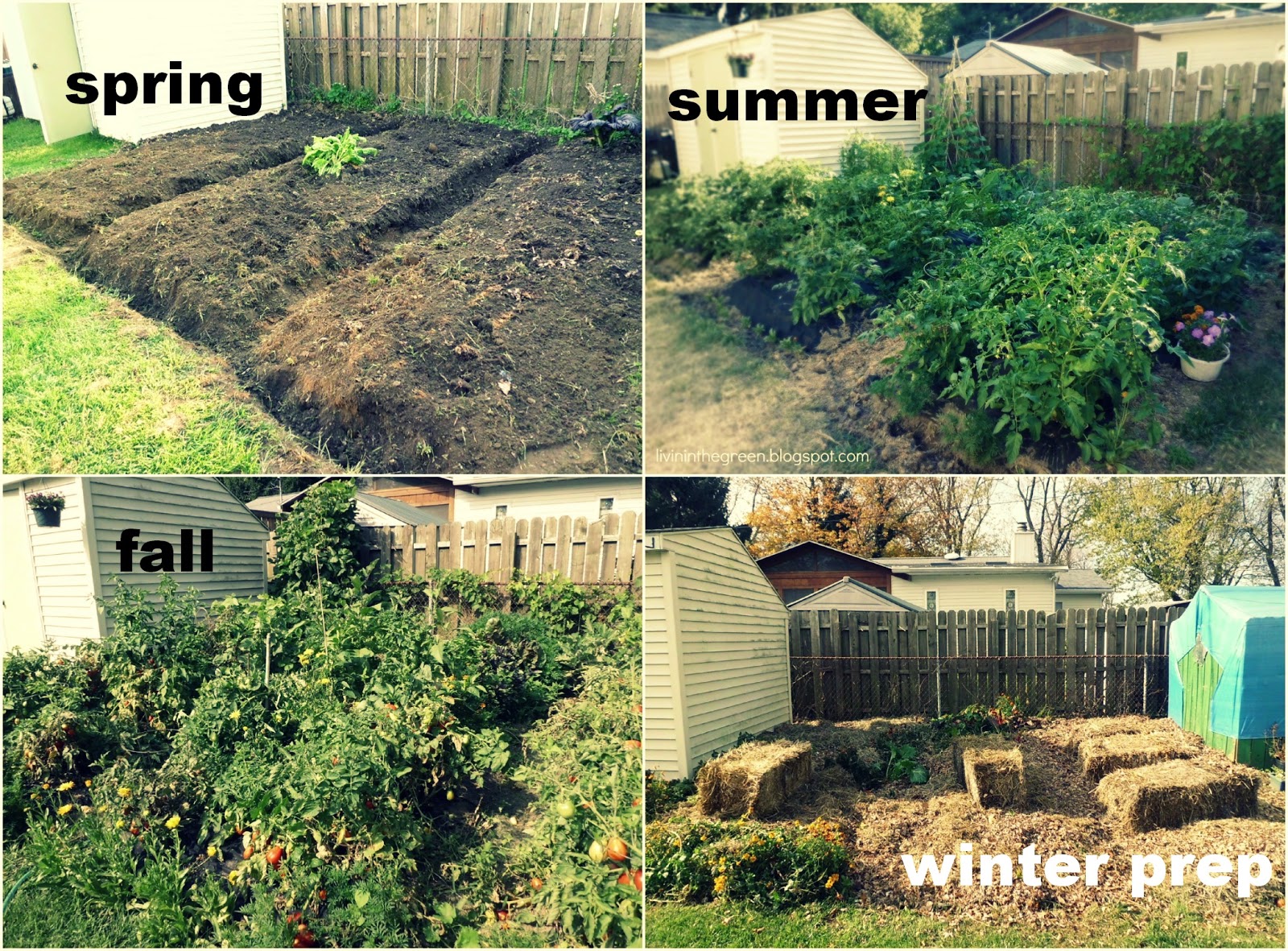
One great thing about blogging about my garden is that it forced me to keep a visual record of the garden for the growing season.  So it was fun putting together this collage of the seasons and to see it all at once.  To be a continuous gardener, you must be visionary and willing to make mistakes.  There's always next year to try out a new method or new vegetable.  The visionary part comes in when you get the soil ready like the soil in the spring photo and can already envision the fall photo in your mind.
 If this garden space looks small, that's because it really is.  But don't let small spaces fool you...with effective gardening, you can get lots of fresh vegetables to eat AND plenty to can, dry and freeze for winter use.


Case in point...these are just a sampling of the produce we got from the garden.  I was able to can 60 jars of whole tomatoes...plus still lots more for fresh eating and fresh marinara sauce.  Our beans and summer/winter squash came from our community garden plot; another option for those with small spaces.  This is our fourth year there and we've finally figured out what vegetables grow well there...tomatoes not being one.  However, the squash did well and the beans, so we'll concentrate on those vegetables.  We're going to try sweet potatoes there next year too as the soil is great for root crops. To see my favorite picks for this year's vegetables, click here.

Well, that's it for the garden 2012...I'll be reading up on some other blogger's great ideas for gardening over the winter while our soil rests and we rest!  SO thankful for all the great food we've gotten from a little space...it's the gift that keeps on giving!

Do you garden or plan to soon?  

Linked to these amazing blog hops...Homestead Revival 
Clever Chicks  Lisa Leonards Design
Farmgirl Friday Living Green Tuesdays
Frugal Days, Sustainable Ways 
Waste-Not, Want-Not Wednesdays Wicked Good Wednesdays
Simple Lives Thursday Farmgiril Friday Blog Hop

Tuesday, April 24, 2012

Making Your Beds - Garden Style

    We aren't this far along this year with our garden as of yet, but I had these pictures from last year, so thought I would talk about prepping your garden.
     We have an extremely small yard, but lots of enthusiasm, so we have this small garden in between our wood storage "shed" and our storage shed.  It's large enough for all our greens, some beans and whatever else I can think to put here.  
     Last year I grew several different types of basils.  Purple, Lettuce Leaf and Lemon to name a few.  
Todd, hard at work
     I always grow too much basil.  It just happens. I start it from seed IN the garden itself.  I've tried starting it in containers and transplanting it, buying plants from the store, etc...but the way it seems to work the best is to just plant it in the garden.
     I think if you wait until the soil really warms up well, it just takes off and always would catch up and look much healthier than any transplants.
      Todd is working hard with this amazing Honda rototiller.  A friend of ours who doesn't garden anymore is letting us use this as long as we garden.  It's a definite back saver! There are different theories about the usage of rototillers, some for them and some against their use, but it seems to work for us. We rototill leaves, grass clippings and whatever else right in so it will add to the soil.

     When we dig into the garden, we can actually see all the new "dirt" that has been made and the clay dirt mix of the original back yard....nice!  
     What helps with this is our compost bin.  I have a very lovely stainless kitchen bin that I empty into our large yard compost container.  Yes, all those veggie scraps, coffee grounds, tea bags (paper kind only), and eggshells all combine with leaf material to make a nice hummus-y mix.  It's a great way to recycle household waste, and use up yard waste to 
The robins love to go through the soil to find any stray worms!
actually make something that will benefit your garden.  We take all of the old flower stocks from the flower beds and place them in a big pile to work on breaking down.  This will become a nice bit of soil after awhile.


Why "make" dirt?  Have you seen the prices of dirt lately? It's crazy and if I can keep my garden waste out of landfill to make FREE dirt, then well, there you go!
Happiness is...my shiny kitchen compost bin, found online.
So, the compost begins it's life in the kitchen in this most lovely of compost containers.  It was actually a birthday gift a few years back.  I kept asking my sister for one for my birthday and she finally broke down and against all her love of shopping, bought me this beauty! Ahhh!  I guess beauty is in the eye of the beholder, but I have to say that the birthday I received it is forever burned into my memory as a very happy day indeed!

This was the garden growing in mid-June.  The large pyramid in back is for my pole beans.  I have lettuce going on on the far left, mustard greens and turnip green, arugula and broccoli raab.  Notice the raise beds too. During a bad rainstorm, parts of our yard can get a little flooded.  The raised beds actually help keep the plants above the water line.  Raised beds also tend to warm up faster and provide good drainage.  We also place a thin layer of grass clippings on the walkways to keep down weeds and eventually enrich the soil.  It's important to go easy putting on a lot of green clippings as they tend to steal nitrogen from the soil around them which is needed to help them break down.  
This is the garden when it's still a baby.  We have one more bed to the right which is out of the picture because it wasn't planted yet but was waiting for basil.  So nice!
Well, here's to dreaming about your garden beds...can't wait until ours gets done!  Very soon we hope!  Be blessed!